The Kuk Sool Hwe and the Legacy of Choi Yong Sool

Updated: Feb 28, 2025
Hapkido is one of the most dynamic and multifaceted Korean martial arts, blending striking, kicking, weapons, joint locks, and throws into a thoroughly comprehensive martial art. Hapkido's origins are traced to Grandmaster Choi Yong Sool and his return to Korea from Japan after World War II. during this period of his life, he would teach what he learned to his Korean students, who would make the art their own. In fact, there is an often-overlooked chapter in the art's history that shaped its early development: the role of Kuk Sool Hwe (Korean Martial Arts Association) in organizing and standardizing the teachings that would become modern Hapkido.
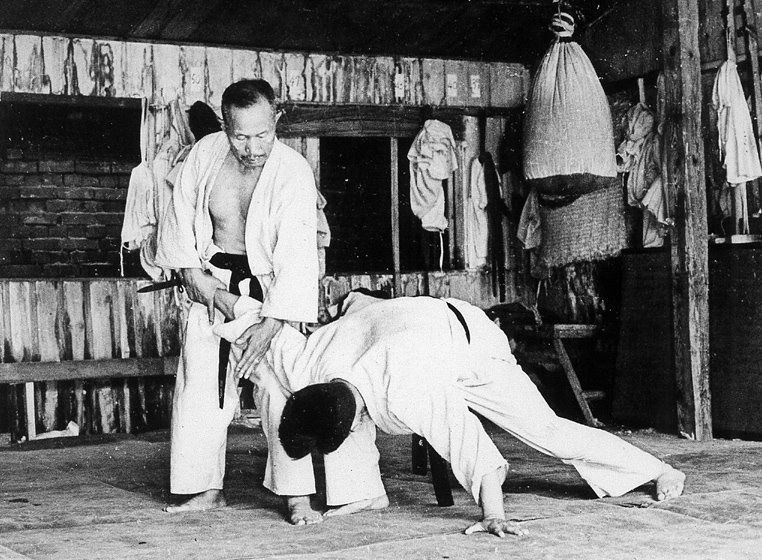
Choi Yong Sool and His Training in Japan
The narrative of Hapkido's origins begins with Choi Yong Sool, a Korean who spent much of his early life in Japan. It is widely accepted that Choi trained under Takeda Sokaku, the master of Daito-Ryu Aiki-jujutsu, a highly sophisticated system of joint manipulation and throwing techniques that later influenced Aikido. However, contrary to some claims, Choi was not formally adopted by Takeda, nor was he likely to be an officially recognized disciple in the conventional sense. Instead, historical evidence and anecdotal reports suggest that Choi, taken to Japan as a child during Korea's colonial period, was utilized primarily as a "grappling dummy" for Takeda Sensei and that it is through his time being practiced on by Takeda Sensei he was able to decode and learn Daito-Ryu. Choi's exposure to Daito-ryu was thus one of immersion rather than structured instruction. It was likely due to his resilience and physical conditioning that he became a favored training partner, allowing him to absorb the techniques through experience rather than formal rank progression. The claim that he was adopted by Takeda appears to be either a misunderstanding or a highly informal arrangement, as no official records from the Daito-ryu lineage corroborate this assertion.
The Rise of Kuk Sool Hwe and Hapkido's Evolution
Upon returning to Korea after Japan's defeat in World War II, Choi began teaching his interpretation of Daito-ryu techniques, which would later form the foundation of Hapkido. However, it was not an immediate or solitary effort. In the 1950s, several of Choi's students and other martial artists formed Kuk Sool Hwe, an organization dedicated to developing and promoting Korean martial arts. This association was crucial in standardizing the techniques and concepts that would eventually define Hapkido. The Kuk Sool Hwe was instrumental in spreading Choi's teachings, which he at the time simply called "Yawara," and integrating Indigenous Korean martial influences into the system. Unlike Choi, who focused primarily on close-quarters joint locks and throws, some of his students sought to broaden the art by incorporating traditional Korean kicking and striking techniques. Among these students, Ji Han Jae is particularly notable for expanding Hapkido's curriculum and popularizing it under the name we recognize today.

Kuk Sool Hwe's Legacy in Modern Hapkido
The role of Kuk Sool Hwe in Hapkido's history cannot be overstated. While Choi's technical knowledge provided the foundation, this association's organizational efforts allowed Hapkido to develop into a complete and systematic martial art. The group fostered an environment where practitioners could refine techniques, introduce new elements, and establish a structured syllabus. However, as time passed, various splinter groups emerged, leading to different interpretations of Hapkido. Some schools remained more faithful to Choi's original jujutsu-based approach. In contrast, others incorporated high-flying kicks and weapons training, influenced by Taekwondo and traditional Korean martial arts. The Final Standing Member of the Kuk Sool Hwe who was a student of Grandmaster Choi's, Grand Master Kim Woo-Tak, would fold the majority of the Kuk Sool Hwe's Shared Curriculum into The Kuk Sool Kwan (not to be confused with Grand Master In Hyuk Suh's similar Kuk Sool Won project) in 1962.
Conclusion
The history of Hapkido is as complex as the techniques it teaches. While Choi Yong Sool is rightly credited as the art's progenitor, his personal story and training under Takeda Sokaku are often romanticized. His role as a "grappling dummy" rather than a formal student challenges the myth of direct Daito-ryu transmission. Additionally, the influence of Kuk Sool Hwe in shaping Hapkido's evolution is often overshadowed by individual narratives.
Understanding this nuanced history allows us to appreciate Hapkido not just as the work of one man but as a collective effort that drew from various influences to create one of Korea's most formidable martial arts. Kuk Sool Hwe's contributions helped ensure that Choi's knowledge would not be lost but refined into today's diverse and effective system.


Comments